
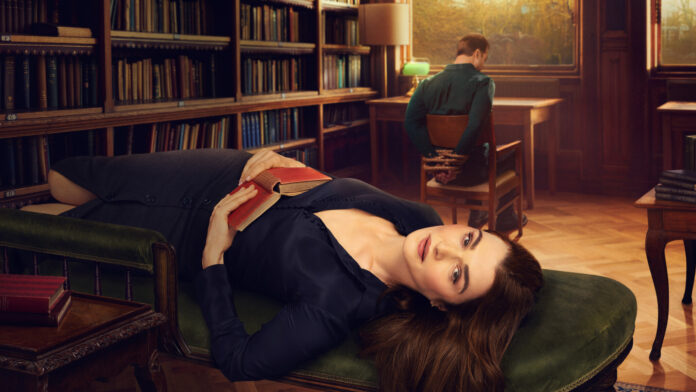
Desire is the presence of absence. We yearn acutely for things or people that we do not possess; the greater the desire, the more powerful the disappointment. It’s akin to Gatsby’s profound despair when he says to Daisy: “You loved me too?” Despite the inevitable disillusionment, desire is the fuel of life. It propels you forward, fills you up with its charming effervescence. It’s palpable, intoxicating, and as the protagonist says, perhaps the closest thing to holiness we have.
When we meet our protagonist (played by the incomparable Rachel Weisz) – yes that is how she is referenced for the entire show – she is at a difficult point in her life. Her husband John (John Slattery), also a professor like herself, has been removed as chair of the department due to the case against him. About 10 years ago, he slept with some of his students, essentially abusing his position and authority. 6 of them have joined the suit against him, and the protagonist is also receiving some of that heat. Her students judge her for not speaking out because it gives the impression that she is okay with her husband’s actions. I mean, she says she is (this is debatable since she does not end up supporting him), but she’s not allowed to take that stand due to the weight of public opinion. It doesn’t help matters when John begs her to intercede on his behalf, where once again it comes across like she’s supporting his horrid behaviour. It’s a point of view that we’ve never considered before – why are the wives and partners of those accused equally embroiled?
An underrated moment in the show is when their daughter Sid (Ellen Robertson), who initially supported her father and felt that these women were consenting adults, has a change of heart when she actually hears their testimony. Yes they are technically adults, but he exploited his position of power to take advantage of them, and it feels satisfying at the end to see Sid actually recognise that. Robertson’s micro-expressions are insanely good, and it’s the mark of good storytelling when a TV show can get viewers to immediately arrive at a conclusion without any words exchanged.
It’s while dealing with the fallout of her husband’s actions that she meets Vladimir Vladinski (Leo Woodall), and she falls head over heels in lust with him. Every single time she comes into contact with him, she’s carried off in a reverie of hot fantasy. So the air practically sizzles between them, and she breaks the fourth wall frequently to let us into her mind and thoughts. Woodall has become the poster boy for older women fantasies; he recently played the younger boyfriend to Bridget Jones in the fourth movie. He plays the part of swoon-worthy younger man fairly well – he’s effortlessly charming and has amazing chemistry with both Weisz and Jessica Henwick (she plays his wife Cynthia). But because he is the object of desire, he isn’t characterised much beyond the protagonist’s insatiable need for him. It becomes rapidly clear that the protagonist just needed a blank slate to project her desires onto, and he fit the bill.
The show works as much as it does because of Weisz. She brings a certain nuance to this unlikeable woman, and makes her someone unflinchingly real. She is a character who lives in the world of fiction more than reality, because reality is less romantic and incredibly unsatisfying. Weisz brings this manic, ethereal quality to her performance; watching her we think: “God, what a mad woman”, yet we envy this bubble world she’s created for herself. A world of raised hands against a bookshelf, of near kisses and hair pulling – nestling herself cozily in the moment between moments.
It’s this imagined love affair that gets her writing again, which proves the potency of desire. We all need muses to set our world ablaze, but in doing so we invite destruction into the fold. It becomes clear that both the protagonist and Vladimir are using each other for creative material, because keeping things status quo creates stagnancy that kills the creative spirit. Every aspect of real life becomes a possible scene in a literary world, with the pair proving that they are willing to tear things apart just for something honest on a page.
The protagonist refers to her age many times throughout the show; she is acutely aware that she is past her prime and does insecurely wonder if Vladimir could ever be interested in her, especially when he has a young beautiful wife. It’s hard to imagine someone as luminous as Weisz feeling insecure about her age (Weisz is also 50-ish, much like the protagonist), but when so much of a woman’s value is her beauty and her looks, it’s no wonder we develop feelings of agency from being desired.
Vladimir won’t satisfy those in search of a spicy, torrid watch, because that’s not what the show is about. It’s about a woman’s search for agency and self, and getting it, much like the heroines in gothic novels, through the epic statement of a blazing fire.
REVIEW SCORE: 4/5