I cannot overstate the brilliance of The Devil Wears Prada. The commentary on toxic work culture is keenly portrayed in a job that is often glamorised, with the film giving us a bare-faced Miranda Priestly (Meryl Streep) to highlight the cost that comes with such ruthless ambition. Andy Sachs (Anne Hathaway) leaves because she doesn’t want to be in a position where backstabs and betrayals are a necessary part of doing your job.
So you can understand how I went into this sequel expecting something fairly decent, even if it could not recapture the greatness of its predecessor. You don’t wait 20 years to write a sequel and bring back all the actors if you don’t have something amazing up your sleeve. Unfortunately, nothing about this is memorable, not the characters or even the fashion. It starts out promising. Andy has just won a journalism award and also been sacked, all in the same breath. It’s a great scene because it’s built on the reality of how things are now in the world of journalism and writing. People want quick soundbites and short videos, and the demand for long-form writing had dipped tremendously. The industry is struggling, with so many wonderful writers and journalists fired from their jobs because publications have been bought over by people who care more about the bottom line. However, after this initial finger-on-the-pulse moment, the film shows us this reality is only for people who aren’t Miranda Priestly and co.
After Andy’s award acceptance speech goes viral, Runway’s owner decides to hire Andy as the features editor as a way to bring credibility to the brand after Miranda made the mistake of singing the praises of a fast fashion company with shady practices. So now Andy’s back, which defeats the whole purpose of her choice in the first film but I guess ethics don’t mean much in this job economy. Miranda has some kind of dementia (not really) and doesn’t remember her – nor can she remember Emily (Emily Blunt). Oh, and now she hangs her own coats due to HR complaints of her mistreating employees.
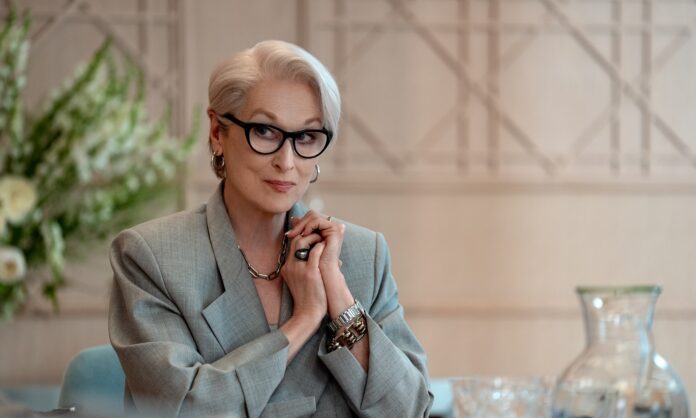
While this makes sense for the times we currently live in, the defanging of Miranda Priestly means that she’s just a ghostly version of her former character. At times, it almost feels like Streep is sleepwalking through this film because she is given barely anything to chew on. In regular Streep fashion, she’s still able to deliver witty putdowns and a severe glance, but these moments feel like mere echoes of the earlier film. Moreover, Andy, who is supposedly an award-winning journalist, behaves like some bright-eyed ingenue. That shtick was fine for the first movie because that’s what she was, but now, even after 2 decades as a journalist, somehow she’s still not very self-assured. They frame it as Stockholm syndrome and the result of being back in Miranda’s orbit, but I wish I got to see Andy more in her element than out of it once again.
The movie also saddles her with an unconvincing boyfriend, one that Hathaway doesn’t have chemistry with, yet has the audacity to take up so much screentime. Narratively his character has purpose, since he’s the architect of the condos that used to be a historical building – once again a link to the movie’s commentary on how humanity is moving away from making art to accepting mediocre creations. However, I feel like the point could have been made easily without this character. At least she had chemistry with both Adrian Grenier and Simon Baker in the first film. I would rather see any form of interaction with either of those men than this boring Peter.
The only one who delights and is very much the same character is Stanley Tucci’s Nigel, who has fantastic comedic timing and quietly supports Andy much like he did in the first movie. Though it does say something about how self-centred Miranda is that she only thinks to give him much-deserved credit 20 years after the fact. I find it highly unbelievable that a talent like Nigel hadn’t left for greener pastures long ago.
Much like the Harry Potter book business in the first movie, Andy is able to pull off the impossible which impresses Miranda and gets her back into her good graces. The rest of the movie is about the sale of Runway, with Miranda and Andy fighting hard to keep and maintain it as a publication. But do they really fight, or do things land on their plate oh-so-neatly?
Miranda’s conversation with Justin Theroux’s techbro speaks to the downward spiral that humanity is inevitably crashing towards, with A.I and tech dominating all conversations of the future, and spaces devoted to art and culture all gradually disappearing. This is why Timothée Chalamet’s whole opera/ballet soundbite went so viral this year, it’s because we’re aware that he speaks the truth yet we cannot bring ourselves to acknowledge it. It’s a candid and frank conversation – the irony is that the film itself is as artificial as the things it desires to spurn. It has no desire to be a film that has something important to say.
All it wants to do is cash in on our nostalgia, bringing back all the characters we loved only to dilute them down to barely recognisable versions of themselves. We want something sincere and real, instead all we’re given is a hollow fairy tale. I guess all you need to save journalism is to find someone with an interest in preserving the written word and lots of deep pockets. Maybe this is hopeful stuff if you believe in unicorns.
REVIEW SCORE: 2.5/5