
Spoilers for Sense and Sensibility (2026) to follow. You have been warned.
Ang Lee’s 1995 Sense and Sensibility is just a masterpiece. Stellar cast, fantastic screenplay and gorgeous direction. I did enjoy the TV mini series that came out in 2008 – Dan Stevens as Edward Ferrars played a huge part in my enjoyment of that – but I knew nothing could topple the juggernaut that is Ang Lee’s Sense and Sensibility. I did have high hopes for this latest adaptation, and while the film itself is well-made, it is a mediocre adaptation. It desires to be as iconic as Joe Wright’s 2005 Pride and Prejudice but cannot measure up. Sense and Sensibility strives to be a more emotive adaptation, leaning more on sensibility to drive home its themes, but the end result is so overwrought that it feels more Bronte than Austen.
The Dashwoods are thrown into a state of turmoil due to the passing of Mr. Dashwood. Their home is no longer theirs, and they must survive with barely any money. The family suffer the consequences of entailment; their home cannot even belong to them because they are not men. When John (Tom Brooke) and Fanny Dashwood (Stacy Martin) come to lay claim of the property, the one bright spot is Fanny’s brother Edward (George MacKay). As Elinor (Daisy Edgar-Jones) and Edward spend more time together, feelings start to develop and an attachment is formed.
MacKay is very good at yearning; we see it in his eyes, his hands, his body language. There’s also a lot of attention to hands in the film, quite a common way for period pieces to signal affection since they can’t do any outward display of physical intimacy, though it feels more choreographed than authentic. I was quite excited for Daisy Edgar-Jones as Elinor, and I can honestly say she’s the best part about the adaptation. She does incredibly well as Elinor, never quite wearing her heart on her sleeve like Marianne (Esmé Creed-Miles) but when she does pour out the emotions, she makes you feel everything she’s been holding so tightly in her chest. Yet, there are far too many passionate outbursts that they sort of blur together and it makes her final heart on her sleeve moment a little bit of a letdown.
Edgar-Jones and MacKay are a good looking pair and visually, more well-matched than Thompson and Grant were, however, the film doesn’t do the work to convince us of why they fall for each other in the first place. It’s very love at first sight coded, and the very thing that Elinor admires so much about Edward is lost in this version. In the novel, Edward’s engagement was his own choice, borne out of youthful naivete. As he matured and saw more of the world, he began to see that he and Lucy would not suit. This was compounded after he met Elinor, who was truly his match in every way. But his honour would not allow him to prioritise his own self-interest over his moral code. In this version, Edward gets engaged to Lucy as some type of moral stand against his mother’s materialism, and not only that, asks Elinor to give him permission to break it off. For Edward to even put Elinor in that position is unfathomable and so unlike the character from Austen’s world. The screenplay never endeavours to show us why the pair should end up together – their pairing cannot be treated as a foregone conclusion just because you’re adapting established characters.
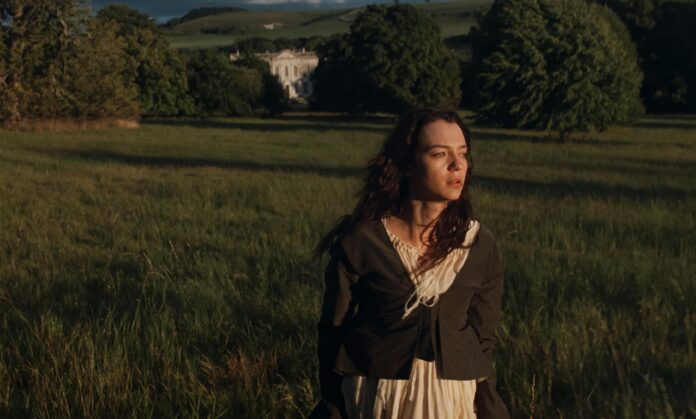
I do like the naturalistic setting, and the gorgeous sunkissed landscapes where the characters frolic about, yet it veers too much into melodrama and the gothic at times. There’s this scene where Marianne stands drowning in melancholy, and a whole pack of dogs rush past her. I was surprised at the seething undertones of danger in that scene and how deep Marianne’s anguish was. It almost felt suicidal in the way it was staged, which I do not think was the film’s intention, yet it came across that way. In the novel, Marianne’s solitary walks are because she is miserable and wants to be left alone, her carelessness is what leads to her sickness. She laments her choices after and apologises to Elinor for her lack of sense, but here, it is the other way around, with Elinor so wrecked with guilt for telling Marianne to show more restraint. This is what I mean when I say the film leans into the sensibility of its title a bit too much, when Austen’s novel is about the need for a balance of both.
Marianne’s whole relationship with Willoughby (Frank Dillane) is never heartbreaking to us because this adaptation presents him as a cad from the get go. Dillane is miscast and is unable to conjure the performative gallantry that Willoughby is supposed to have. He looks like some kind of fisherman when we first meet him, and the entire rescue scene plays out like a farce. It’s meant to be funny of course as Marianne is milking the entire moment and enjoying being rescued by a hero, but he never embodies this aspect so essential to the character. When we find out about Willoughby’s betrayal, it is supposed to be a shocking discovery, especially given the public displays of affection he had shown her, but Willoughby is so obviously a villain that it’s hard to pretend otherwise. It was even more shocking to see Dillane and Creed-Miles actually hold hands. I know this was done to replace the lock of hair scene, but it just isn’t as effective or even as intimate.
Maybe it was replaced because hair just doesn’t have the symbolism in this movie that it had in Austen’s novel. The hair is all wrong for a period piece. For Elinor to have her hair down in the presence of Edward was just not of the times, and it was extremely distracting to see Marianne’s hair at times look so disheveled and unkempt. I know the intention is to reflect that ‘sensibility’ spirit that writhes within her, but I think there are better ways to portray this on screen. Whatever their financial status, the Dashwoods were still part of polite society, while the depiction on screen here made them feel more lower class than they actually are. Maybe director Georgia Oakley wanted to dismantle these symbols tied to womanhood – let the women be messy, let the girl eat blackberries and smear it all over face and clothing. That dismantling needs to have a bigger purpose I would say, especially when adapting such a well-loved novel.
Austen’s minor characters are insipid and frivolous but they are integral to the fabric of her novels. In this film they fade away into background noise as the romances take centre stage. Fiona Shaw’s Mrs Jennings is the only one who is properly handled in the screenplay, though I suspect it’s mainly for the humour she brings and for very little else. Take for example Lady Middleston (Chloe Pirrie). Here she’s constantly harping about the weather like a lunatic lacking in social graces, transfigured into some quirky oddball when Austen was using her character to reflect the emptiness of Regency manners.
This adaptation gives us a more youthful Colonel Brandon (Herbert Nordrum), to make the union feel more palatable I suppose. Alan Rickman’s Colonel Brandon is so pitch perfect that I feel sorry for anyone attempting to take on the role because of the inevitable comparison. I did like some aspects of Nordrum’s portrayal. His Colonel Brandon feels sincere and is certainly driven by propriety. The deep undercurrents of passion that still stir within him was done as a way to make him and Marianne a more suitable match, yet at the same time it goes against the whole point of his character in the novel. Marianne learns to love him and grows to appreciate his steady, unflashy goodness. Having him literally duel with Willoughby over Marianne’s honour is the opposite of what his character is supposed to be. I did enjoy the duel scene, it was so camp and hilarious, especially with all the over the top reactions, yet I didn’t find it to be quite in the vein of Austen.
And this is the failing of Sense and Sensibility as an adaptation. These are not the characters we know and love from Austen’s novel. Changes are fine in an adaptation, but the mood and characterisation should largely in keeping with the source material. Look at Clueless or Fire Island – even when the setting is completely different the characters are still recognisable. I don’t recognise the ones present here. What we have is a serviceable movie, but ultimately mediocre adaptation.
REVIEW SCORE: 3/5

