Spoilers for all seasons of Euphoria to follow. You have been warned.
Any review of Euphoria season 3 would be difficult to write, because it’s hard to pin down how exactly we feel about this show. To outrightly praise it is impossible considering the misogyny present in the way women are portrayed – they’re either sex objects or dead. Yet to dismiss it entirely is to ignore its strengths, and there are some. Season 3 of Euphoria expands the world we’re used to dealing with in the prior seasons. It used to be about teenage problems; messy relationships, the social dynamics of high school, teenagers navigating the digital age and trying to find a sense of self. Now, with the 4 year flash forward, the teens are no longer teens, allowing creator Sam Levinson to transpose his characters to a wider stage, that of the sprawling Western epic.
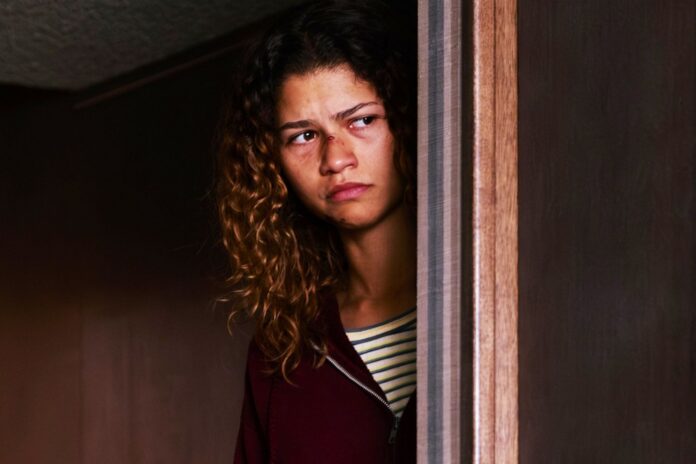
Many have bemoaned this change, comparing it to some kind of “Tarantino pastiche”, lamenting that the show now is very different from the show they used to know. For example, Rue (Zendaya) went from small time drug addict to drug mule and runner for competing crime lords. It’s not far-fetched per se, since this is a direct consequence of Rue’s previous actions in season 2, yet it does feel a bit hyperbolic to see her dodging bullets and getting dragged by a horse across the desert. We’re worlds away from the purplish glitter tones of season 1.
Cassie’s (Sydney Sweeney) decision to start marketing herself on OnlyFans isn’t originally where I saw her arc going after season 2, but Cassie has always seen herself in relation to her body and its value. I could see the pattern Levinson was building, with all these established characters becoming larger-than-life versions of themselves, plucked from suburbia and forced to reckon with terrifying figures like Alamo Brown (Adewale Akinnuoye-Agbaje).
In this season of Euphoria, Levinson wants viewers to ponder this question: what kind of society have we built for the generations that come after us? There is a moral rot that inundates all the decisions these characters make, choices made for money and profit with little consideration for what’s truly at stake. Nate (Jacob Elordi) has issues with Cassie being on OnlyFans until he benefits from her commodification of her body, and despite Maddy’s (Alexa Demie) claim to her boss that she wants to work hard, she’s constantly scheming of different ways to profit and get rich. She encourages women to sell themselves, to get the attention of famous men who can leverage them towards a greater following. This is labelled as empowerment, and while there is the appearance of choice, when we consider all the dynamics at play and the amount of people who get a cut of the profits, does it really end up that way?
Levinson’s inclination as a creator is provocation, which we could fault because an artist should rise above the criticisms of his work. While viewers loudly comment that surely all this sex, violence and nudity is not entirely necessary, his response is to give us a tracking shot of Kitty’s botched BBL, or scatological imagery to remind us that this is a gritty HBO TV show. This could explain his treatment of Nate this season, with the character given barely anything to do but be tortured and mutilated till his death. Nate was certainly disliked by viewers, but this destruction of the character seems Levinson’s way of saying: “You wanted Nate Jacobs dead, well, here it is. Enjoy.”
While I can kinda see Nate getting in over his head with Armenian mob bosses, because all these choices are happening behind the scenes, we don’t really get to experience the pathos of Nate’s decision making. All we see is the horror and the downfall, so his death feels meaningless as a result, besides overtly hammering in the point of how greed and envy drives the capitalist machine.
Rue’s death is better handled; she is the protagonist after all, a stand-in for Levinson himself, so unlike Nate, viewers get to grieve her. As much viewers will disagree with Levinson’s decision, deep down, we have been anticipating Rue’s death since season 1. Her inability to stay clean led her to one frightening situation after the next – there was always a tension when it came to Rue. As the protagonist, our view of this world is shaped by her narration. This technique humanises her, so we like her and relate to her struggles even as we despise her actions. So her death hits hard, especially when it seems like her life was finally taking a positive turn. We wanted so badly for her to have a hopeful ending, but Rue never made the choices that would allow her to experience that.
It’s clear that Rue’s ending is in part driven by what happened to Angus Cloud (he played Fez in seasons 1 and 2), as he succumbed to his addiction and never got the chance to turn his life around. Levinson’s haphazard allegory becomes clear; both Rue and Angus never got to live past their addictions, much like Moses never got to see the promised land, but there is the hope that others will see this and make different choices. In an interview with The New York Times, Levinson doesn’t look at the ending of Euphoria as bleak or hopeless. He notes the “fragility” that comes with living, but thinks that if people can “believe in something a little greater than ourselves, then we can carve out a future.” I don’t think Levinson’s concluding imagery in the show was meant to prop up Christianity, nor suggest adopting a puritan lifestyle. Our world has become increasingly secular, and God is no longer the centre of civilisation. So what are we building our lives around, or towards? He’s saying for him, that’s God, but we get to choose what that is for ourselves.
Season 3 of Euphoria is far from perfect, but I do respect Levinson’s decision to ‘live’ through his art and distill so much of himself into the spaces of the show. He doesn’t have all the answers – naturally – but there is a desire to find out. We should want to, too.